Key Points
The 1929 stock market crash triggered the Great Depression, resulting in massive financial losses for many individuals.
Following the financial crisis, widespread bank failures left people without access to their savings and sparked further economic panic.
Severe droughts led to dust storms that devastated farms and worsened the financial hardships of countless families.
The Great Depression, which lasted from 1929 to 1939, stands as the most severe economic downturn in American history. Economists and historians widely regard the stock market crash on October 24, 1929, as the catalyst for the recession. However, the Great Depression was not caused by a single event; rather, it stemmed from a complex interplay of multiple factors.
In the United States, the crisis paralyzed President Herbert Hoover’s administration and paved the way for Franklin D. Roosevelt’s election in 1932. Roosevelt promised a New Deal to the nation and went on to become the longest-serving U.S. president. The economic slump extended far beyond America’s borders, affecting numerous developed countries. In Europe, one contributing factor to the Depression was the rise of the Nazis in Germany, which sowed the seeds for World War II.
Watch now: What Caused the Great Depression?
The 1929 Stock Market Crash
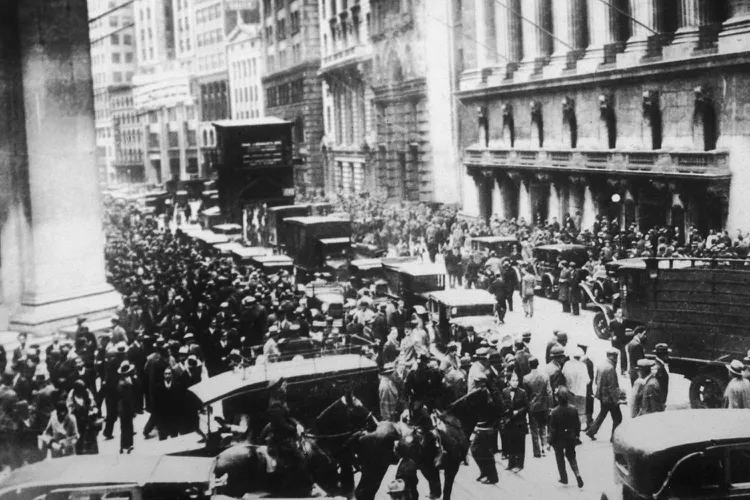
On October 29, 1929—now infamously known as “Black Tuesday”—the New York Stock Exchange on Wall Street collapsed, sending workers into a frenzy as they poured onto the streets in panic.
The stock market crash of October 29, 1929, was neither the sole trigger of the Great Depression nor the first plunge of that month, but it is universally recognized as the most glaring signal of the impending catastrophe. Earlier that summer, the market had soared to unprecedented heights, only to begin a downward spiral in September.
On Thursday, October 24, the market opened with a dramatic plunge, igniting widespread panic. Although investors managed to temporarily halt the decline, just five days later, on “Black Tuesday,” the crash intensified. Stock values plummeted by 12%, wiping out $14 billion in investments in a single day. Within two months, shareholders had lost over $40 billion. Though the market partially recovered by the end of 1930, the broader economy was irreparably damaged. The United States had officially entered what would become known as the Great Depression.
Bank Failures
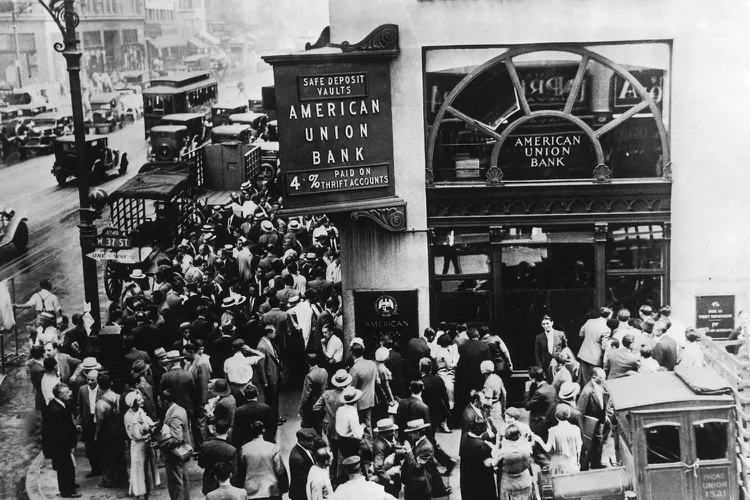
On June 30, 1931, depositors gathered outside the Bank of United States in New York, unable to withdraw their savings before the institution collapsed.
The repercussions of the stock market crash rippled through every sector of the economy. By the end of 1929, nearly 700 banks had failed; the following year, more than 3,000 followed suit, making bank failures one of the primary drivers of the Great Depression. At the time, the federal deposit insurance system did not exist, so ordinary people suffered devastating losses when banks collapsed. Panic spread rapidly, leading to mass withdrawals known as bank runs, which forced even more institutions to shutter their doors. By the late 1930s, over 9,000 banks had gone under. The surviving banks, gripped by uncertainty about the economic climate and their own viability, became reluctant to extend loans. This credit freeze exacerbated the downturn, as reduced lending stifled spending and investment across the board.
Widespread Reduction in Purchasing
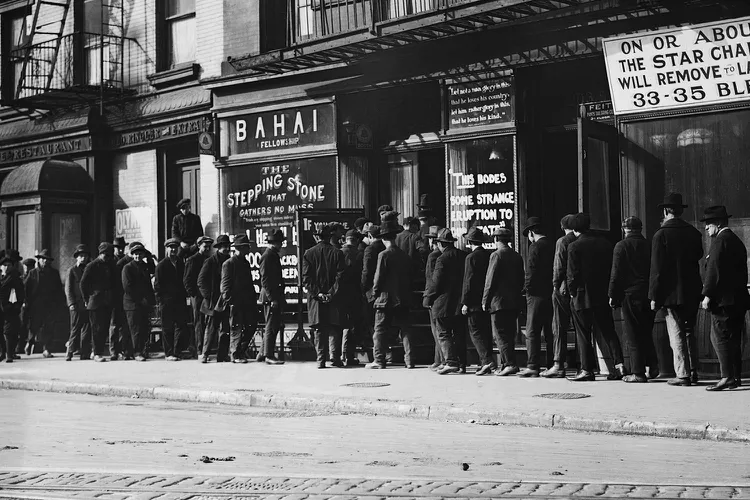
Around 1930, unemployed men lined up at a soup kitchen run by the Bahá’í Center at 203 East Ninth Street in New York to receive coffee and bread.
With investments rendered worthless, savings depleted or entirely wiped out, and credit all but evaporated, both consumers and businesses slashed their spending. This led to massive layoffs as companies cut costs to survive. The domino effect was swift and brutal: unemployed workers could no longer afford installment payments on goods they had purchased on credit, resulting in widespread repossessions of homes and evictions. Unsold inventories piled up in warehouses, further depressing production. Unemployment rates soared above 25%, meaning a quarter of the workforce was jobless and contributing even less to the economy. This vicious cycle of reduced expenditure deepened the crisis, leaving little room for recovery.
U.S. Economic Policies Toward Europe
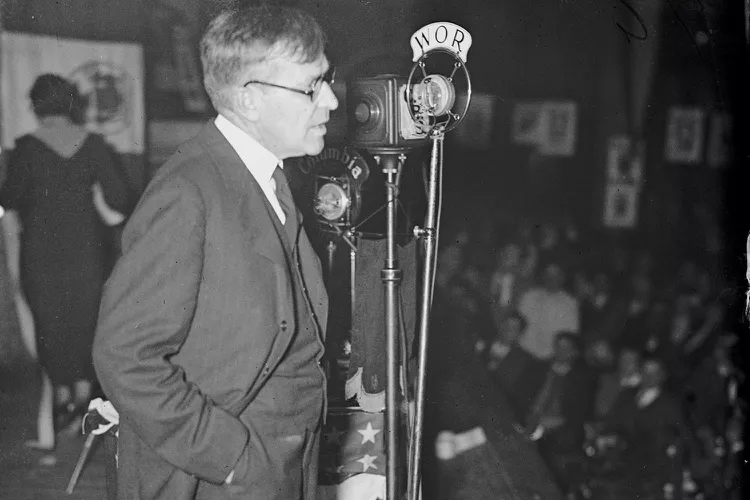
D. Baker denounces the Smoot-Hawley Tariff Act.
As the Great Depression’s grip tightened on the United States, the government scrambled for solutions. In a bid to shield American industries from foreign competition, Congress passed the Tariff Act of 1930—better known as the Smoot-Hawley Tariff Act—which imposed near-record-high duties on a wide array of imported goods. In retaliation, several U.S. trading partners slapped tariffs on American exports. The fallout was catastrophic: global trade volumes plummeted by two-thirds between 1929 and 1934. Eventually, under President Franklin D. Roosevelt and a Democratic-controlled Congress, new legislation empowered the president to negotiate tariff reductions with other nations, marking a shift toward more cooperative international economic policies.
Drought Conditions
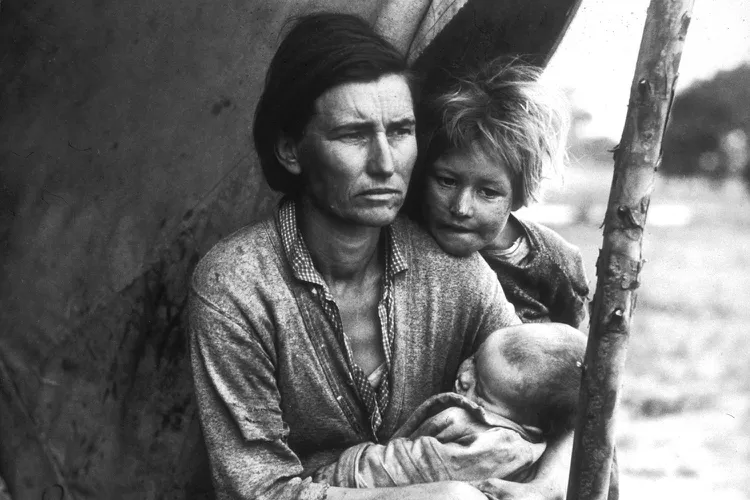
During the Great Depression era, Florence Thompson sits with her children amid the hardships.
One of the most profound contributors to the Great Depression was environmental devastation. Years of relentless drought, compounded by farming practices that neglected soil conservation, ravaged a vast swath of land stretching from southeastern Colorado to the Texas panhandle—an area that came to be known as the Dust Bowl. Massive dust storms engulfed towns, obliterated crops and livestock, caused widespread illness, and inflicted millions of dollars in damages. As the economy crumbled, tens of thousands fled the region in desperation, a migration immortalized by John Steinbeck in his epic novel *The Grapes of Wrath*. The ecological scars in this area would take years, if not decades, to heal.
The Legacy of the Great Depression
While other factors undoubtedly played a role in the Great Depression, historians and economists generally pinpoint these five as the most critical. Together, they spurred sweeping government reforms and the launch of innovative federal programs—many of which endure today, including Social Security, federal support for conservation farming and sustainable agriculture, and federal deposit insurance. Although the United States has weathered several significant recessions since, none have matched the depth, breadth, or duration of the Great Depression.
Home
detail
The 5 Major Causes of the Great Depression
2025-09-15T15:29:50
Key Points
The 1929 stock market crash triggered the Great Depression, resulting in massive financial losses for many individuals.
Following the financial crisis, widespread bank failures left people without access to their savings and sparked further economic panic.
Severe droughts led to dust storms that devastated farms and worsened the financial hardships of countless families.
The Great Depression, which lasted from 1929 to 1939, stands as the most severe economic downturn in American history. Economists and historians widely regard the stock market crash on October 24, 1929, as the catalyst for the recession. However, the Great Depression was not caused by a single event; rather, it stemmed from a complex interplay of multiple factors.
In the United States, the crisis paralyzed President Herbert Hoover’s administration and paved the way for Franklin D. Roosevelt’s election in 1932. Roosevelt promised a New Deal to the nation and went on to become the longest-serving U.S. president. The economic slump extended far beyond America’s borders, affecting numerous developed countries. In Europe, one contributing factor to the Depression was the rise of the Nazis in Germany, which sowed the seeds for World War II.
Watch now: What Caused the Great Depression?
The 1929 Stock Market Crash
On October 29, 1929—now infamously known as “Black Tuesday”—the New York Stock Exchange on Wall Street collapsed, sending workers into a frenzy as they poured onto the streets in panic.
The stock market crash of October 29, 1929, was neither the sole trigger of the Great Depression nor the first plunge of that month, but it is universally recognized as the most glaring signal of the impending catastrophe. Earlier that summer, the market had soared to unprecedented heights, only to begin a downward spiral in September.
On Thursday, October 24, the market opened with a dramatic plunge, igniting widespread panic. Although investors managed to temporarily halt the decline, just five days later, on “Black Tuesday,” the crash intensified. Stock values plummeted by 12%, wiping out $14 billion in investments in a single day. Within two months, shareholders had lost over $40 billion. Though the market partially recovered by the end of 1930, the broader economy was irreparably damaged. The United States had officially entered what would become known as the Great Depression.
Bank Failures
On June 30, 1931, depositors gathered outside the Bank of United States in New York, unable to withdraw their savings before the institution collapsed.
The repercussions of the stock market crash rippled through every sector of the economy. By the end of 1929, nearly 700 banks had failed; the following year, more than 3,000 followed suit, making bank failures one of the primary drivers of the Great Depression. At the time, the federal deposit insurance system did not exist, so ordinary people suffered devastating losses when banks collapsed. Panic spread rapidly, leading to mass withdrawals known as bank runs, which forced even more institutions to shutter their doors. By the late 1930s, over 9,000 banks had gone under. The surviving banks, gripped by uncertainty about the economic climate and their own viability, became reluctant to extend loans. This credit freeze exacerbated the downturn, as reduced lending stifled spending and investment across the board.
Widespread Reduction in Purchasing
Around 1930, unemployed men lined up at a soup kitchen run by the Bahá’í Center at 203 East Ninth Street in New York to receive coffee and bread.
With investments rendered worthless, savings depleted or entirely wiped out, and credit all but evaporated, both consumers and businesses slashed their spending. This led to massive layoffs as companies cut costs to survive. The domino effect was swift and brutal: unemployed workers could no longer afford installment payments on goods they had purchased on credit, resulting in widespread repossessions of homes and evictions. Unsold inventories piled up in warehouses, further depressing production. Unemployment rates soared above 25%, meaning a quarter of the workforce was jobless and contributing even less to the economy. This vicious cycle of reduced expenditure deepened the crisis, leaving little room for recovery.
U.S. Economic Policies Toward Europe
D. Baker denounces the Smoot-Hawley Tariff Act.
As the Great Depression’s grip tightened on the United States, the government scrambled for solutions. In a bid to shield American industries from foreign competition, Congress passed the Tariff Act of 1930—better known as the Smoot-Hawley Tariff Act—which imposed near-record-high duties on a wide array of imported goods. In retaliation, several U.S. trading partners slapped tariffs on American exports. The fallout was catastrophic: global trade volumes plummeted by two-thirds between 1929 and 1934. Eventually, under President Franklin D. Roosevelt and a Democratic-controlled Congress, new legislation empowered the president to negotiate tariff reductions with other nations, marking a shift toward more cooperative international economic policies.
Drought Conditions
During the Great Depression era, Florence Thompson sits with her children amid the hardships.
One of the most profound contributors to the Great Depression was environmental devastation. Years of relentless drought, compounded by farming practices that neglected soil conservation, ravaged a vast swath of land stretching from southeastern Colorado to the Texas panhandle—an area that came to be known as the Dust Bowl. Massive dust storms engulfed towns, obliterated crops and livestock, caused widespread illness, and inflicted millions of dollars in damages. As the economy crumbled, tens of thousands fled the region in desperation, a migration immortalized by John Steinbeck in his epic novel *The Grapes of Wrath*. The ecological scars in this area would take years, if not decades, to heal.
The Legacy of the Great Depression
While other factors undoubtedly played a role in the Great Depression, historians and economists generally pinpoint these five as the most critical. Together, they spurred sweeping government reforms and the launch of innovative federal programs—many of which endure today, including Social Security, federal support for conservation farming and sustainable agriculture, and federal deposit insurance. Although the United States has weathered several significant recessions since, none have matched the depth, breadth, or duration of the Great Depression.
9 websites where you can earn money just by watching videos, earning $3000 in a month
2025-08-19T17:33:27
0-Barrier Ways to Earn Dollars Online: Make Money Watching Videos and Listening to Music
2025-10-11T09:45:27